The Financial Anatomy of a Filipino Doctor's First Five Years in Private Practice
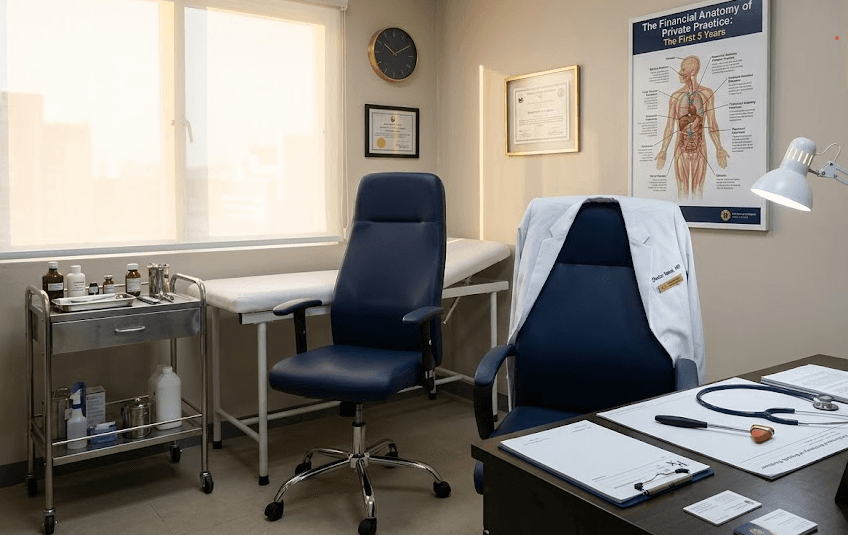
There is a quiet gap in Filipino medical training that almost no one talks about.
You spend four to six years in pre-med, four years in medical school, one year in internship, three to seven years in residency, sometimes another two to three years in fellowship — and at the end of that fifteen-to-twenty-year pipeline, no one teaches you how to make a clinic financially work. You graduate as a consultant with intricate knowledge of disease pathophysiology and zero formal training in patient acquisition, business cash flow, vendor management, BIR compliance, or the negotiation logic of HMO accreditation contracts.
The training system assumes you will figure it out. Most doctors do, eventually — but the journey is harder than anyone explains in advance, and the financial pattern is remarkably consistent across specialties and locations. A solo doctor in Quezon City and a multi-clinic owner in Cebu follow recognizably similar arcs. The differences are scale and timing, not structure.
This article maps that journey across the first five years of private practice, using real peso numbers drawn from current PH industry data, a 2022 qualitative study of junior internal medicine consultants from a major university hospital, and patterns we've observed in actual doctor practices. It is the article we wish every fellow had a chance to read in their final year of training.
By the end you'll understand: what your finances will probably look like in year one (and why almost everyone underestimates this), where the inflection points are, why some doctors plateau at ₱200,000/month while others compound past ₱1M/month within five years, and what the early-career financial decisions are that genuinely matter.
This is not motivational content. The first three years are difficult, financially and emotionally, and pretending otherwise serves no one. What follows is an honest map.
Year Zero — The starting line, and what you bring to it
Year zero is the day you complete training. For most Filipino doctors, this happens between ages 30 and 38, depending on specialty length. By this point you have likely accumulated a specific stack of financial conditions:
Income trajectory to date. Your residency stipend was modest. Resident doctors in the Philippines typically earn between ₱30,000 and ₱60,000 per month during training.1 Fellowship pays slightly better — typical fellow stipends in PH programs range from ₱30,000 to ₱70,000 per month, with select competitive tertiary programs reaching ₱80,000.2 For most of the preceding 7–10 years, you have been living on training stipends.
Educational debt. Medical school in the Philippines costs roughly ₱100,000 to ₱250,000 per year in tuition, depending on the institution3 — and that's before books, equipment, transportation, or board review courses. For doctors whose families could not absorb the full cost, the cumulative educational debt at the end of training can sit between ₱500,000 and ₱2,000,000.
Family expectations. By the time you finish training, you are 30+, possibly married, possibly with children, very likely supporting parents. The financial expectations on a freshly-minted consultant are immediate. People assume you are now wealthy. You are not.
Savings. Most fellows finish training with savings between ₱0 and ₱200,000. Many finish with negative savings — credit-card balances from review courses, board exams, conference fees, and the inevitable lifestyle creep of the final year.
Starting compensation reality. Here's where the gap between expectation and reality is widest. A newly-minted consultant in high-demand fields like cardiology, gastroenterology, or dermatology in Metro Manila can expect starting salaries from approximately ₱100,000 to ₱200,000 per month, while provincial settings may start ₱80,000 to ₱150,000 per month — though cost of living is lower and competition is thinner.2 The bigger picture: those numbers describe what an established consultant earns — not what a fresh consultant generates in their first 12 months. The first 12 months are different.
Year One — The Wilderness Year
This is the hardest year financially, and no one is going to warn you adequately.
In 2022, a research team at the University of Santo Tomas conducted a qualitative study of ten internal medicine consultants who had finished training between 2013 and 2018.4 The most striking finding wasn't about clinical practice — it was about the financial and psychological reality of the first 12–24 months.
The young consultants reported being eager to work but having few or no patients to consult.4 Sitting in empty clinics waiting for patients was described as frustrating. There were workdays when they considered not showing up at all because no patients were expected. When friends or relatives did visit for consultations, they typically waived the professional fee. Some reported going home each day having spent more than they earned, with their clinic secretaries and drivers out-earning them in the early months.4
This is the wilderness year. Three things are happening simultaneously:
1. Capital is going out fast. Setting up even a modest single-clinic practice requires real money. A typical solo-clinic setup in a hospital arcade or commercial building in Metro Manila looks something like:
- Clinic space deposit (2 months) and first month rent: ₱40,000–₱120,000
- Renovation / fit-out (signage, basic furnishings, electrical, partitions): ₱150,000–₱400,000
- Essential medical equipment (BP apparatus, exam table, otoscope/ophthalmoscope, stethoscope-grade, basic diagnostics): ₱80,000–₱300,000 (depends heavily on specialty)
- Office furniture, computer, EMR or scheduling software: ₱50,000–₱150,000
- BIR registration, books of accounts, Authority to Print, business permits, barangay clearance: ₱5,000–₱25,000
- Specialty-specific equipment (ultrasound for OB, slit lamp for ophtha, dermatoscope, etc.): ₱100,000–₱2,000,000+
- 3 months of operating reserve (clinic staff salary, rent, utilities, supplies before patient revenue stabilizes): ₱100,000–₱250,000
Total realistic Year 0 capital outlay for a solo doctor in Metro Manila: ₱525,000 on the very lean end, ₱1,500,000+ for a properly-equipped specialty clinic, and ₱3,000,000+ for procedure-heavy specialties (ophtha, derma cosmetic, OB ultrasound).
For doctors with no inherited capital, this is usually financed through a combination of personal savings, family loans, and equipment financing. Bank loans are rarely accessible to a freshly-minted consultant with no audited revenue history.
2. Patient flow is structural, not motivational. Even with the best clinical skills and a great hospital affiliation, your first year of clinic patient flow is determined almost entirely by structural factors:
- Whether you have HMO accreditation (and which HMOs)
- Whether your clinic location has high foot traffic
- Whether senior consultants in the area refer to you
- Whether you have an active personal/professional network that knows you've started practicing
- Whether you are visible on directory listings (hospital websites, HMO directories, Google Maps)
You can be the most skilled cardiologist in the country and still see 4 patients a day in month three. The market doesn't care about your competence yet. They don't know you exist.
The JMUST study found that most junior consultants ended up working multiple clinics and visiting several hospitals simultaneously during their first one to two years of practice — both to maximize patient exposure and to generate enough income to live on. They also reported that in the first year or two of practice, they handled mostly general Internal Medicine cases rather than the subspecialty work they trained for, since referrals for subspecialty consultation came slowly.4
3. The hospital affiliation politics. This is the part nobody tells you about during training. In urban areas with established practices, junior consultants reported being perceived as competitors by senior consultants when starting practice in hospitals where established subspecialists were already operating. Most participants had to seek approval from senior consultants before being allowed to hold clinic hours at a given hospital.4 In provincial settings without established subspecialists, the dynamic flips: there's open territory, but there is also the awkwardness of having to actively “sell” your subspecialty to a community that doesn't know what it is.
Year 1 financial profile
What do the numbers actually look like? Here's a realistic Year 1 profile for an internal medicine subspecialist in Metro Manila who has set up one solo clinic and visits two hospitals as a consultant:
Revenue sources:
- Solo clinic professional fees: ₱40,000–₱80,000/month (averaging 4–8 patients per clinic day, 3 clinic days/week, at ₱700–₱1,500 PF5) by month 6–12
- Hospital-based consultancy fees: ₱15,000–₱40,000/month
- HMO consultations: ₱10,000–₱30,000/month once accredited (usually 4–8 months in)
- ER on-call work (if accepting): ₱20,000–₱60,000/month
- Occasional hospital paneling, speaking engagements: ₱5,000–₱20,000/month
Year 1 typical gross revenue: ₱700,000 to ₱1,500,000
Year 1 typical expenses:
- Clinic rent and utilities: ₱360,000–₱600,000
- Clinic staff salaries (1 secretary): ₱120,000–₱200,000
- Equipment depreciation: ₱100,000–₱300,000
- Malpractice insurance, PRC fees, PMA dues, CME: ₱50,000–₱120,000
- Supplies and consumables: ₱60,000–₱180,000
- Marketing (online listings, business cards, basic website): ₱20,000–₱60,000
- Transportation (multiple clinic sites): ₱60,000–₱180,000
Year 1 typical operating expenses: ₱770,000 to ₱1,640,000
Year 1 net practice income (before personal tax): often -₱100,000 to +₱200,000
That number is not a typo. Many Filipino doctors lose money on their clinic in Year 1, even when their gross revenue looks respectable. They are paying full overhead while patient flow ramps from near-zero to barely-sustainable. The income that keeps them solvent comes from outside-the-clinic work — hospital visits, ER duties, HMO consultations, paneling.
This is the moment many young consultants get psychologically rattled and start taking on every available opportunity to generate income — sometimes too many to sustain quality clinical work. The JMUST study described this pattern explicitly: participants accepted multiple clinic affiliations and hospital visits in the first one-to-two years to cover as much practice area as possible and to generate enough income to live on.4
Year Two — The Crossover Year
Year two is the year the math starts to work.
By the second year of practice, several things have happened that fundamentally change the financial picture:
Patient flow stabilizes. Word-of-mouth begins to compound. Patients who saw you in Year 1 return for follow-ups and refer family members. The clinic that saw 4 patients/day in month 6 is now seeing 8–12. HMO referrals start flowing more predictably. Your name has begun to appear on hospital department directories and HMO accreditation lists.
HMO accreditation matures. Most HMOs have a 6–12 month onboarding/credentialing cycle. By Year 2, you should be accredited with at least 3–5 of the major HMOs — Maxicare, MediCard, Intellicare, PhilCare, ValuCare. The combined network of major Philippine HMOs covers more than 50,000 accredited doctors across 2,000+ hospitals and clinics,6 and most established physicians need multiple HMO accreditations to capture the corporate-insured patient base. Each HMO accreditation adds 5–15 new patient appointments per month at steady state.
Hospital affiliations stabilize. The “are you competing with my practice?” dynamic from Year 1 has been navigated. You've built working relationships with senior consultants who now refer down. You have predictable hospital consultancy schedules at 1–3 hospitals. Your name is on referral lists.
You stop accepting marginal opportunities. In Year 1 you said yes to every speaking gig, every ER shift, every weekend duty. In Year 2 you've learned which engagements produce stable downstream revenue (a regular HMO panel) versus which just consume your time (one-off corporate health talks for ₱5,000). You begin to ration your time deliberately.
Year 2 financial profile
Year 2 typical gross revenue: ₱1,500,000 to ₱2,800,000
The range expands here because individual circumstances diverge. A doctor who locked in 5 HMO accreditations and 3 stable hospital affiliations by month 18 will be at the top of the range. A doctor with 1 HMO and an isolated solo clinic will sit at the bottom.
Year 2 typical operating expenses: ₱900,000 to ₱1,800,000
Expenses are now more stable — rent is locked, staff is hired and trained, equipment is bought and depreciating, supplies are systematized.
Year 2 typical net practice income (before personal tax): ₱600,000 to ₱1,000,000
For the first time, the practice is generating real, predictable income. This is also the year tax compliance becomes critical. If you didn't register for BIR books, ATP, and proper quarterly 1701-Q filings in Year 1, this is the year the catch-up costs become visible. (See the seven most expensive tax mistakes doctors make — mistake #1 in particular.)
Year Three — The Inflection Year
Year three is where the curve bends. Three things converge:
1. Recurring patient base. Most doctors find that by Year 3, roughly 50–70% of their clinic patient appointments are returning patients — chronic disease management, follow-ups, family referrals. This base is the most valuable asset a private practice owns. Unlike new-patient flow (which is unpredictable), the returning base is a near-guaranteed revenue stream as long as you maintain clinical quality.
2. Subspecialty work picks up. Remember the JMUST finding that junior consultants spent their first 1–2 years handling general IM rather than their subspecialty? By Year 3, the referrals for actual subspecialty consultation have started flowing. The cardiology subspecialist is now seeing complex cardio cases, not just hypertension follow-ups. Subspecialty cases bill at higher PFs and often lead to procedures.
3. Procedure or program income kicks in (for procedural specialties). This is the most dramatic year for doctors in specialties with procedural revenue streams — derma cosmetic, OB-GYN with ultrasound, ophthalmology, GI endoscopy, plastics. A single derma cosmetic procedure can generate ₱8,000–₱40,000. A single endoscopy can generate ₱15,000–₱50,000. Once a procedural specialist has 100–150 monthly patient encounters, the procedure pipeline alone can match all consultation revenue combined.
Year 3 financial profile
Year 3 typical gross revenue: ₱2,500,000 to ₱4,500,000 (cognitive specialties)
Year 3 typical gross revenue: ₱3,500,000 to ₱8,000,000 (procedural specialties)
Year 3 typical operating expenses: ₱1,200,000 to ₱2,400,000
Year 3 typical net practice income: ₱1,200,000 to ₱2,500,000 (cognitive); ₱2,300,000 to ₱5,000,000 (procedural)
Year 3 is also when the ₱3M VAT registration question becomes real. Many doctors cross the threshold this year. Most don't realize it — and the BIR catches up later with retroactive VAT exposure. (How to think about the VAT transition →)
This is also typically the year when doctors stop being employees of their own practices and start thinking strategically about expansion: adding a second clinic location, hiring an associate, investing in additional equipment, or considering corporate structures.
Year Four — The Multiplication Year
Year four is when growth strategy starts to differ dramatically by practice type. Three patterns emerge:
Pattern A: Solo consolidation. The doctor stays single-clinic, single-location, but matures the operations. Clinic days expand from 3 to 5/week. Staff grows from 1 secretary to 2–3 (secretary, nurse, billing/admin). Patient appointment slots tighten and PF increases incrementally. This pattern caps out somewhere around ₱4–7M annual gross for a cognitive specialist, ₱8–12M for a high-volume procedural specialist.
Pattern B: Multi-clinic expansion. The doctor opens a second clinic in a different geography — typically a different city or a nearby suburb. The second clinic shares staff, supplies, and back-office systems with the first, which compresses operating overhead. This pattern can push gross revenue to ₱6–15M annually within Year 4, depending on how aggressively the second clinic ramps.
Pattern C: Hospital-anchored growth. The doctor doubles down on hospital affiliations — becoming an active staff at a major tertiary hospital, joining the medical staff committee, building admission volume. Inpatient consultation fees, surgical assistance fees, and PhilHealth-billed services produce a different income stream than clinic-based work, often with higher per-encounter PFs but more bureaucratic billing cycles.
Year 4 financial profile (varies by pattern)
Pattern A (Solo consolidation): Gross ₱3,500,000–₱6,500,000 | Net ₱1,800,000–₱3,500,000
Pattern B (Multi-clinic): Gross ₱6,000,000–₱15,000,000 | Net ₱2,500,000–₱6,000,000
Pattern C (Hospital-anchored): Gross ₱5,000,000–₱12,000,000 | Net ₱2,200,000–₱5,500,000
In every pattern, Year 4 is the year when meaningful personal wealth begins to accumulate. Income exceeds reasonable lifestyle expenses by a wide margin. This is also typically when doctors first encounter the question: what do I do with the surplus? — which is the beginning of investment, real estate, and long-term wealth conversations that most doctors are completely unprepared to navigate.
Year Five — The Compounding Year
Year five is where the differences between practice strategies become large. The same specialty, the same training, the same intelligence — but radically different financial outcomes based on operational decisions made in Years 2–4.
By Year 5, a successful Filipino consultant in private practice typically falls into one of three financial profiles:
The Conservative Path
Year 5 gross revenue: ₱4,000,000–₱7,000,000
Year 5 net income: ₱2,000,000–₱4,000,000
The doctor maintains a single, well-run clinic. Patient flow is stable. Staff is competent. The brand is established locally. The doctor works 4–5 clinic days per week plus hospital visits. They don't pursue expansion because they don't want the complexity. They are comfortable, well-paid, and respected.
This is the most common Year 5 profile, and it's not a failure mode — it's a deliberate choice that produces a comfortable upper-middle-class lifestyle.
The Moderate Growth Path
Year 5 gross revenue: ₱8,000,000–₱18,000,000
Year 5 net income: ₱4,000,000–₱8,000,000
The doctor has 2–3 clinics in different locations, an associate doctor or two, established HMO panels, regular speaking/training engagements, and possibly some passive revenue from real estate or healthcare-related investments. Operations are complex enough to require a full-time business manager or accountant.
This is the profile that 20–25% of established Filipino consultants reach by Year 5.
The Aggressive Growth Path
Year 5 gross revenue: ₱15,000,000–₱40,000,000+
Year 5 net income: ₱7,000,000–₱18,000,000+
The doctor has built a small clinic group or partnered into a medical practice corporation. There are 3+ clinic locations. Multiple associate doctors are employed. The owner-doctor spends roughly half their time on clinical work and half on business operations. They are sometimes VAT-registered, often incorporated, frequently engaged in adjacent ventures (medical supplies, healthcare products, real estate).
At this level, well-known specialists in Metro Manila can earn ₱500,000+ per month, and some surpass ₱1,000,000 monthly through multiple clinic affiliations and procedural volume.3 This is the profile that ~5% of Filipino consultants reach.
What separates the paths
The differences between Conservative, Moderate, and Aggressive Year-5 outcomes have remarkably little to do with clinical skill. The doctors who reach the higher tiers tend to share five characteristics:
1. They treat their practice as a business from Year 1. Books of accounts registered with BIR. Quarterly 1701-Q filings. Separate clinic and personal bank accounts. Real bookkeeping, not Excel sheets. This sounds boring. It is also the structural foundation that allows them to take advantage of opportunities later — including bank financing for expansion, clean tax positions for incorporation, and the ability to actually see what's working.
2. They reinvest aggressively in Years 2–3. Instead of upgrading lifestyle the moment net income exceeds ₱150,000/month, they reinvest in additional equipment, a second clinic location, a marketing budget, or an associate. The doctors who plateau at Conservative-path income often do so because they prematurely scaled their personal expenses to match their first sustained income level.
3. They build referral relationships deliberately. Not just with senior consultants, but laterally — with peers in adjacent specialties, with HMO medical directors, with hospital administrators. Referrals are the most underpriced source of patient flow in PH medicine, and most doctors are passive recipients rather than active builders.
4. They get serious about pricing early. The doctor who stays at the ₱700–1,000 PF range for five years because “that's what new doctors charge” is leaving substantial income uncollected. Established consultants in Metro Manila with strong reputations charge ₱1,500–3,000 for routine consultations and ₱3,000–8,000 for complex cases.5 Pricing power is built by clinical excellence and signal management, not by waiting for permission.
5. They have a CPA, not an accountant. This sounds like a self-serving point, but it isn't. A general bookkeeper records transactions. A CPA who understands medical practice optimizes tax structure, helps you plan around the ₱3M VAT threshold, runs the 8% vs graduated comparison annually, files cleanly enough to keep BIR off your back, and helps you make decisions about incorporation, real estate, and investment that compound over decades.
What to do differently if you're at Year Zero now
If you're a fellow or resident planning your transition to private practice in the next 12–24 months, here is the highest-leverage advice we can offer based on the patterns above:
- Save aggressively in your last 6–12 months of training. You will need ₱500,000–₱1,500,000 in deployable capital for clinic setup. The fewer loans you carry into Year 1, the easier the wilderness year will be.
- Apply for HMO accreditation 4–6 months before you finish training. The accreditation cycle takes 6–12 months. Most doctors don't start until they've finished, which means they have no HMO patient flow until late Year 1.
- Don't sign a long-term clinic lease in Year 1. Sign month-to-month or short leases until you understand which location actually produces patient flow. Many doctors lock into 3-year leases at locations that don't work and lose six figures before they can exit.
- Set up BIR registration, books of accounts, and quarterly filing systems on Day 1. Not Year 2. Not after you start earning. Day 1. The compounding cost of tax non-compliance is the single most preventable financial mistake doctors make.
- Plan to be net-negative for 9–15 months. Have a budget that assumes your clinic loses money for that long. If you've planned for it, it's manageable. If you haven't, it's catastrophic.
- Build the referral network actively, starting in your final year of training. The senior consultants who will refer to you in Year 2 are the ones you build relationships with in Year 0. The HMO medical directors who will accredit you are the ones you meet at conferences in your fellowship year.
- Pick a CPA who serves doctors before you start the practice. Not after. The setup decisions made in months 1–3 of practice (business structure, books format, regime election, BIR registration) cast long shadows. Getting them right is dramatically easier than fixing them later.
A free Year-1 financial model for your private practice
We've built a one-page Year-1 Private Practice Financial Model — an Excel template you can fill in with your own numbers to project your first 12 months of clinic operations: capital requirements, monthly revenue ramp by source, operating expense schedule, and projected net income with break-even timing.
It's free. We just want you to follow the page. Drop your details and we'll send it →
The Filipino doctor's private practice journey is a five-year compounding game. The first 12 months will probably be harder than you expected. The second 12 months will be the year the math starts working. Years 3–5 are where the differences between conservative, moderate, and aggressive paths emerge — and almost all of those differences come from decisions made in the early years.
If you're approaching the start of practice, or you're in the wilderness year right now and looking for a clearer map, we offer a free 30-minute consultation for Filipino doctors. No commitment, no pitch. We'll review your specific setup — capital plan, location decision, BIR readiness, projected revenue ramp — and tell you the three things we'd do differently if we were in your seat.
Footnotes
- BossJob.ph. “How Much is the Salary of Doctor in Philippines?” Published January 10, 2026. Resident doctor compensation during specialty training reported at PHP 30,000–60,000 per month, characterized as a training allowance rather than a full salary. ↩
- “Fellow Doctor Salary In The Philippines: What To Expect.” Published January 6, 2026. Fellow stipends typically PHP 30,000–70,000 per month across Philippine training programs, with select competitive tertiary programs reaching PHP 80,000+. Starting consultant compensation in high-demand Metro Manila specialties reported at PHP 100,000–200,000 per month, while provincial settings begin at PHP 80,000–150,000 per month. ↩
- Salary Grade Philippines. “Doctor Salary In Philippines Per Month 2025.” Published October 29, 2025. Medical school tuition reported at PHP 100,000–250,000 per year depending on institution. Private-sector specialists and consultants reported earning PHP 120,000–600,000+ monthly, with well-known specialists in multi-clinic practice surpassing PHP 500,000–1,000,000+ per month. ↩
- Mesina FZ, Collante MTM. “Challenges and Experiences of Young Medical Specialists in Establishing Private Clinical Practice.” Journal of Medicine, University of Santo Tomas, Volume 6, Issue Supplement 1, pp. 39–49, December 2022. DOI: 10.35460/2546-1621.2022-sp06. ↩
- MedicalPinas. “Check Up Price of Doctors in the Philippines: Consultation Service Fees.” Published October 2, 2024. Survey of consultation fee ranges across major specialties in Philippine private hospitals and clinics: general practitioners PHP 500–1,500, dermatology PHP 700–1,000, cardiology PHP 700–1,500, oncology PHP 1,800–2,500. ↩
- HMO accredited network data compiled from: (a) iCare HMO Philippines, reporting 50,000+ accredited doctors across 2,000+ hospitals and clinics nationwide; (b) ClinicFinderPH, “How to Choose an HMO in the Philippines (2026),” published April 2026, reporting Maxicare as the largest Philippine HMO by revenue with 1.8 million members and a network of approximately 1,300+ hospitals and 20,000+ doctors. ↩
Share this article
Found this useful?
Know a doctor about to start private practice? This is the financial map we wish every fellow had before their first clinic day.
Comments
Loading comments…
Magat CPA
Free 30-minute practice review
We'll review your capital plan, location decision, BIR readiness, and projected revenue ramp — and tell you the three things we'd do differently if we were in your seat. Honest numbers, no pressure, no commitment.
Alvin Magat, CPA, CIA, REB, MDP
Alvin is a Certified Public Accountant, Certified Internal Auditor, PRC-licensed Real Estate Broker, and Management Development Program graduate based in the Philippines. He founded Magat CPA to serve Filipino doctors exclusively — because specialization compounds, and physicians deserve accountants who actually understand mixed-income reporting, CME deductions, and the BIR's particular interest in high-earning professionals.
The five-year financial profiles in this article are illustrative and drawn from current industry data and a 2022 qualitative study of junior internal medicine consultants by Mesina and Collante (Journal of Medicine, UST). Individual practice outcomes vary substantially based on specialty, location, family circumstances, and the operational decisions discussed above. Always work with a licensed CPA before making decisions specific to your practice.